
Why So Many Dental Claims Get Denied the First Time (And What You Can Do About It)
This post, authored by Alvin Uta’i, unpacks why dental claims face high first-pass denial rates explaining EDI edits, payer rules, and documentation gaps in plain English for dental office leaders. It highlights how Elite Dental Force and EDiFi empower teams to submit clean claims the first time, setting a new industry standard for efficiency and accuracy.
Let’s Call Out the Pain: Denied on the First Try
If you’re a dental office manager, practice owner, or biller, this probably sounds familiar:
- You submit a perfectly reasonable claim.
- Days, sometimes weeks later, it comes back denied or “pending more info.”
- Now your AR ages, your team is on the phone, and your patient is frustrated.
- The cycle repeats.
You’re not alone. Industry data shows anywhere from 15% to 30% of dental insurance claims are denied on the first attempt. In some groups, that number is even higher for out-of-network or specialty procedures.
Here’s the hard truth: This is not a “staff problem” it’s a system problem.
I’ve walked in your shoes, built billing teams from scratch, and fought with the same payers you do every day. What have I learned? If you want clean claims the kind that pay fast and don’t boomerang back you have to understand the machinery working behind the scenes.
Why Do Claims Really Get Denied? Breaking Down the “Invisible Walls
Let’s peel back the layers. Most first-pass denials fall into three buckets:
1. EDI Edits: The Hidden Filters
Every claim you submit gets funneled through Electronic Data Interchange (EDI) systems think of them as ultra-strict robots looking for a reason to reject you before a human ever sees the claim.
- What they check: Did you include all required fields? Are the codes up to date? Is every data point in the right format?
- What happens: Missing a single key detail (“subscriber’s ID off by one digit”)? Automatic rejection.
- Why it stings: Dental payers run these edits FAST. Speed is good—unless you’re stuck fixing repeat errors.
Example:
You submit a claim for a crown (D2740), but your ICD-10 diagnosis isn’t populated (cracked tooth, K03.81). The payer’s EDI system instantly flags it. No diagnosis, no “why,” no approval.
2. Payer Rules: The Moving Target
Now, imagine every insurer has their own “secret recipe.” These are not always public and they change often.
- Frequency: Major carriers tweak documentation and coverage rules 2,4 times per year.
- What’s tricky: Requirements can be buried in updates or provider bulletins (who has time to read all those?!).
- Typical troublemakers: Narrative is missing, X-ray angle isn’t right, wrong code is paired with a specific benefit, etc.
Example:
A patient needs scaling and root planing. You attach your perio chart, but the payer this month starts requiring full-mouth X-rays your claim is kicked back, and now you’re chasing paperwork rather than payments.
3. Documentation Gaps: The Devil in the Details
Clean documentation is the backbone of every paid claim. But “clean” isn’t always clear especially when you’re racing the clock or juggling a packed schedule.
- Common missteps:
- No clinical narrative or insufficient detail
- Missing attachments (X-rays, perio charts, photos)
- ICD-10 diagnosis doesn’t match procedure code
- Patient/member info that doesn’t sync with payer records
- Impact: Each gap triggers a denial or a request for more records, stretching out your AR and stressing your team.
Quick Stat:
Since 2025, Medicare Advantage and many commercial plans have required ICD-10 codes for dental claims. Skip this, and payment is denied by default.
Real-World Impact: How Denials Break Practices (and People)
Denials aren’t just administrative headaches they have real, measurable impacts on dental teams, owners, and patients.
Time Lost:
Every denial means your team spends another 10, 30 minutes reworking, calling, and resubmitting. Multiply that by dozens of claims weekly.
Cash Flow Pain:
AR ages, billing lags, and sometimes claims are written off entirely. Nationally, I’ve seen write-offs spike north of 8% just from preventable denials.
Staff Burnout:
Your front and back office came to help patients not play insurance detective. Chasing down records and sitting on hold with payers isn’t why anyone chose dentistry.
Patient Trust:
Patients get frustrated when “insurance said no.” It’s not your team they just can’t see the system working against you.
So, How Do You Get Clean Claims the First Time? My Framework

Here’s what I tell every DSO, office manager, and owner: The single best time to fix a denial is before it happens.
But that’s not about working harder it’s about building smarter workflows and giving your team the right tools.
1. Front-Load Your Eligibility and Pre-Checks
- Verify eligibility and benefits before the patient sits down. Not after.
- Batch-verification and real-time “same-day check” catch inactive plans and coverage limits.
- Store snapshots of eligibility so you always have proof.
2. Standardize Documentation (Every. Single. Claim.)
- Use checklists: Is the clinical narrative done? Did you attach all needed X-rays/photos?
- Populate diagnosis (ICD-10) codes for every covered procedure even when it “seems obvious.”
- Double-check patient/member data for correct spelling and IDs.
3. Automate Where Possible But Don’t Ignore Human Review
- Lean on AI and automation for basic edits and formatting, but have a “two-eyes rule” for high-dollar or complex claims.
- Use systems that flag common missing items (narrative, attachment, codes) before submission.
4. Establish a “Feedback Loop” With Insurers
- Track which claims get denied and why. Not just from EOBs—create an internal denial log.
- Share learnings with your whole team, monthly. Turn denials into training points.
5. Monitor Edits and Payer Changes, Relentlessly
- Assign someone to stay on top of payer bulletins (even if that’s only once per quarter).
- Build a quick-reference guide for payers’ quirks—keep it visible for your team.
The Elite Dental Force & EDiFi Difference: Clean Claims by Design
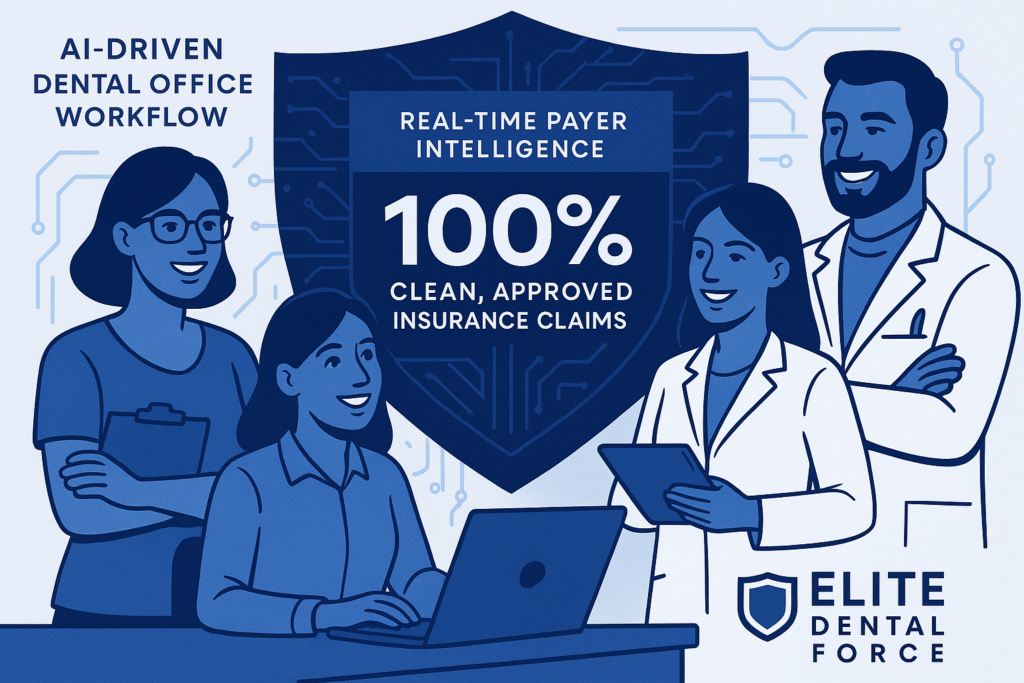
Here’s where we step in not as another “tech company,” but as a partner who’s lived your pain.
Elite Dental Force (EDF) isn’t just about software. We’re built by billers, for billers with Lean Six Sigma rigor and real-world dental office scars. EDiFi, our platform, flips denial prevention from wishful thinking into standard operating procedure.
How EDiFi Delivers Clean Claims:
- Real-Time Eligibility and Batch Pre-Checks:
Don’t wait for headaches to find you, EDiFi runs automated checks before a single claim is created. - Dynamic Documentation Alerts:
Attaching a narrative, radiograph, or perio chart is required? EDiFi makes it impossible to skip that stage. - AI-Powered Edit Checks:
Our bots catch missing codes, mismatched patient info, and risk flags before you hit submit. - Feedback Loop Integration:
Every denial comes back with actionable feedback so your next batch is even cleaner. - Centralized Insights for DSOs:
Instantly see which locations struggle with documentation, which payers are causing the most issues, and drill down by reason code.
This isn’t a pitch it’s a reality check. You deserve systems that make clean claims the default, not the exception.
Tactical Takeaways: Steps You Can Start Today
Connect With Others.
Network with peers and share best practices on clean claim strategies.
Audit Your Last 30 Denials.
Map out which ones were due to missing info, payer edits, or EDI formatting issues.
Create a Submission Checklist.
Get your team to use it, every claim, every time.
Educate Staff on Common Payer Rule Changes.
15 minutes per month can save you dozens of hours down the line.
Invest in Batch Eligibility Tools.
Real-time is great, but for larger schedules, nothing beats reviewing a whole day’s roster in advance.
Track Denials Don’t Just Resolve Them.
Patterns are power. Every denial is a learning opportunity.
The Future State: What Happens When Clean Claims Become the Norm
Imagine a workflow where:
- Your team spends 80% less time on rework.
- Write-offs drop below 2%.
- Patients are never surprised by “not covered” messages.
- Staff spend less time on the phone, more time in patient care.
- You stop chasing payers and start predicting them.
That’s not just possible. It’s happening, right now, in practices using automation, rigorous checks, and feedback-driven workflows.
Dentistry doesn’t need another band-aid. It needs a new operating system.
Let’s Fix Dental Billing for Good
Want to see what clean claims could look like for your practice without the headaches?
Connect with me, Alvin Uta’i, on LinkedIn or book a discovery call with our Elite Dental Force team. Let’s bring clarity, speed, and sanity back to your revenue cycle.
“Ready to break the denial cycle? Connect with Alvin Uta’i on LinkedIn or book a 30-minute discovery call to see how clean claims can transform your bottom line.”